

Rate Markets Update · Friday, January 30, 2026
Dec PPI Prints Worse-Than-Expected
- Trump Nominates Warsh as Next Fed Chair
- Rates Mixed but Mostly Steady
Flash Update: US RATE MARKETS – FRIDAY JANUARY 30, 2026
UST yields and SOFR swap rates opened mixed this morning; Traders await economic data
President Trump announced Kevin Warsh as his nomination for the next FOMC Chairman
Market reaction to the announcement has been minimal; Odds for a rate cut “after June” ticked slightly higher
Traders continue to closely monitor geopolitical developments in multiple “hot spots” (Greenland, Europe, Venezuela, Iran)
A potential government shutdown is also garnering market attention – another disruption to “data releases” could impact rates
A SCOTUS ruling on tariffs is now anticipated to come “at some point in January” – the decision could come any day
Fed officials will emerge from the “communications blackout” today, 1/30
The next FOMC rate decision is due Wednesday, March 18, 2026 at 2:00 PM
Next up for data: January ISM Manufacturing & Prices Paid data is released Monday, 2/2 at 8:30 AM
Short-end SOFR swap rates are trading flat to down ~1-2 bps this morning, depending on tenor
Long-end SOFR swap rates are currently trading flat to up ~1-2 bps, depending on tenor
Good Morning – US Treasury yields and SOFR swap rates opened mixed, but remained in a tight trading range. Traders largely ignored the worse-than-expected PPI data released this morning (for now) and are contemplating a US Central Bank chaired by Kevin Warsh. Warsh is a bit of a mystery that rate markets will be keen to solve as soon as possible. Overall, rates on the short-end of the curve are down a tick or two, and long-terms rates are up a tick or two this morning.
Traders will likely shift focus to several other “hot spots” that could impact US rates including a potential US government shutdown, a deteriorating political situation in Iran and the next series of key economic data.
President Trump has announced his pick for the next FOMC Chairman: Kevin Warsh. Warsh served on the US central bank’s Board of Governors from 2006 to 2011 and has previously advised Trump on economic policy. If confirmed, he would succeed Jerome Powell when his term at the Fed helm ends in May. This is only the very first step in the process, so this will be a developing story over the coming months.
The market reaction to the announcement this morning has been relatively muted – again, this is only the first step in this process. We did see a slight uptick in odds for Fed rate cuts from June on, but overall the odds for rate cuts this year are not shifting dramatically on the announcement. Yes, Warsh has recently echoed Trump’s calls for lower borrowing costs and revamping the central bank, but traders and market participants see him as potentially more hawkish than other candidates for the role given how much he worried about inflation when at the Fed and his more recent criticism of its large balance sheet.
I currently do not have a firm opinion on the Warsh nomination, however, I am initially skeptical. As mentioned, Warsh has traditionally been a monetary policy hawk. From my perspective, Warsh’s recent abrupt policy “about-face” from a hawk to an apparent dove seems more like a “career” move than a change in his monetary policy philosophy.
The main risks associated with a “politically dovish” monetary policy are twofold: One, the US Central Bank risks losing the global confidence it has built over the last 100 years – that could have far reaching implications. The market is very nervous that Fed independence may be compromised. Second, President Trump has called for a Fed Funds rate of 1.00%. With a 2.00% inflation target, that would mean we would have a negative “real rate”. That is a situation we have typically only seen in times of financial crisis or during a black swan event. To me, it means the potential for runaway inflation. Obviously, it is too early to draw any firm conclusions – all will eventually be revealed.
News the market is tracking includes:
Geopolitical developments continue to weigh on market sentiment. Geopolitical tensions continue to run high, and that is not likely to abate anytime soon. Markets will continue to closely monitor the situations in Venezuela, Europe, Iran and Greenland. Geopolitical tensions escalated yesterday as the US stepped up its threats against the Iranian regime. That development once again has global markets nervous and uncertain.
Markets will be tracking developments in the equities markets closely. There is still a sharp focus on the performance of the growing AI sector. Market sentiment is likely to be impacted by “tech” earnings for the foreseeable future.
The Supreme Court ruling on President Trump’s tariffs has not yet been released. The ruling is now expected to come at “some point in January”. The SCOTUS ruling could definitely have market implications. Currently, market participants and economists believe the Supreme Court will rule against the President. Economists are unsure about the market impact of the decision – either way, the ruling is a potential catalyst for elevated rate volatility.
SCOTUS is also currently ruling on the legality of the President firing of the Fed’s Lisa Cook. That ruling is also expected to come in the near term. Chair Powell said yesterday that this is “the most important legal case in the Fed’s history”. Stay tuned!
President Trump has “asked” Fannie Mae and Freddie Mac to purchase ~$200 billion in mortgage-backed securities in order to facilitate lower mortgage rates. The market impact is uncertain at the moment. A sudden surge in purchases could impact rates and the shape of the yield curve, at least in the short-term. We will continue to track this developing story.
The US Justice Department investigation into the US Central Bank and Chairman Powell is likely to remain a key market focus moving forward.
Traders will continue to track developments with the US dollar – the recent weakness, and reaction of the US government, has baffled markets. Sustained currency weakness can be inflationary. A weak dollar can lead to “pricier” imports and a deterioration in investor confidence.
Bottom-line, there are many potential market catalysts for traders to monitor and manage at the moment.
SOFR Swap Rate Summary: The 1Y SOFR swap rate is trading flat to down ~1-2 bps this morning. 2Y and 3Y SOFR swap rates are currently trading flat to down ~1-2 bps. 5Y and 10Y SOFR swap rates are currently trading close to unchanged on the day. The very back-end of the swap curve is currently trading up ~1-2 bps from yesterday’s closing levels.
Please note: Market levels can change rapidly – rate cap premiums are subject to a dynamic market that can change frequently.
CHART 1:US RATES SNAPSHOT: 9:30 AM Eastern
*For SOFR Swap Rates & Change-On-Day (In Bps): Refer Two Far Right Columns (SOFR Swap Rates)
UST YIELDS | SWAP SPREADS | SOFR SWAP RATES
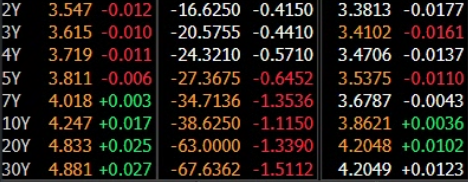
Source: Bloomberg, LLP | 9:30 AM NY Rates Snapshot
CHART 2, 2A & 2B: SOFR SWAP RATES MIXED AS MARKET SHRUGS-OFF PPI DATA, DIGESTS WARSH NOMINATION
SOFR swap rates opened mixed this morning. Short term swap rates ticked a touch lower and long-term yields drifted slightly higher. Nothing dramatic. After a hectic couple of weeks, it feels like the market is pausing to regroup ahead of the economic data we will see in the coming weeks. That said, markets this morning have initially shrugged-off the much higher-than-expected December PPI data. I do not know if that is still due to “data skepticism” created by the “shutdown”, or if traders simply have “bigger fish to fry” at the moment. I do also think that Chair Powell’s comments that both short and medium term inflation forecasts are favorable helped traders to avoid an overreaction to today’s inflation data.
Forces likely to impact swap rates in the near term include the worsening situation in Iran and the impact on oil prices, a potential US government shutdown and upcoming US economic data. Key economic data on the horizon includes: January ISM Manufacturing data on 2/02; December JOLTS jobs report on 2/03; January ISM Services data on 2/4; January CPI on 2/11; January Employment Report on 2/6.
Here are the current odds for a Fed rate cut at the next four meetings: March, 15.4% (vs. 13.5% the prior day); April, 31.2% (vs. 26.1% prior); June, 65.4% (vs. 61.5% prior); July, 77.6% (vs. 73.8% prior). Right now, traders do not expect a rate cut in the first quarter of 2026, but they do suspect that the installment of a new Fed chief could green-light a rate cut in June or July. Currently, forward market pricing implies 49.9 bps of cumulative rate cuts in 2026 (~two, 25 bp rate cuts) – that number was 47.4 bps yesterday. As you can see, the Warsh nomination has thus far done little to materially impact Fed rate cut odds.
CHART 2:Short-End SOFR Swap Rates – Prior 30 Days
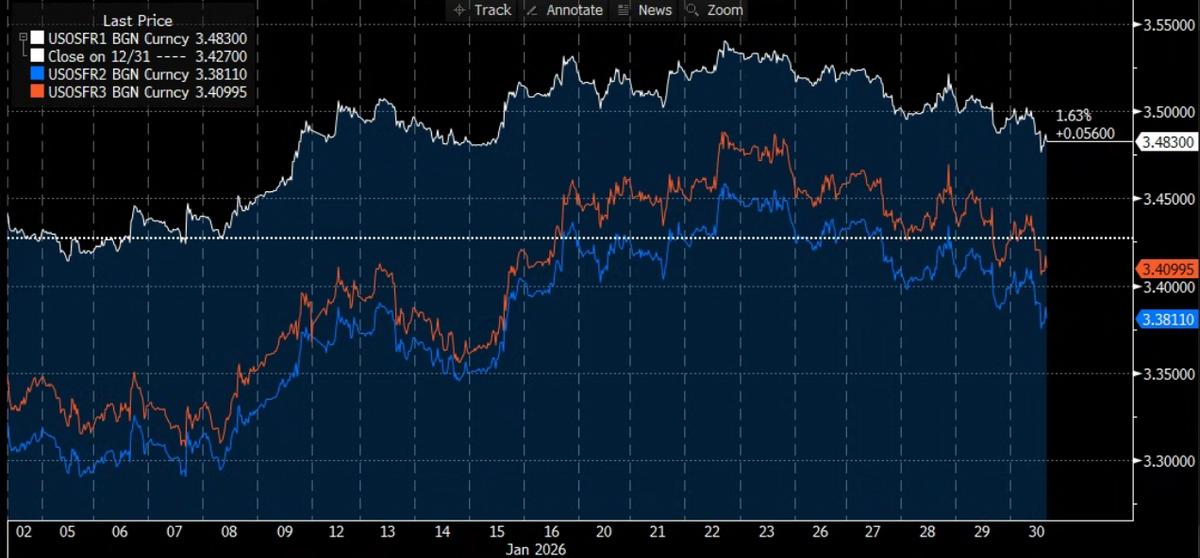
Source: Bloomberg, LLP | 1Y (white), 2Y (blue) & 3Y (orange) SOFR SWAP RATES, PRIOR 30 DAYS
CHART 2A:Long-End SOFR Swap Rates – Prior 30 Days
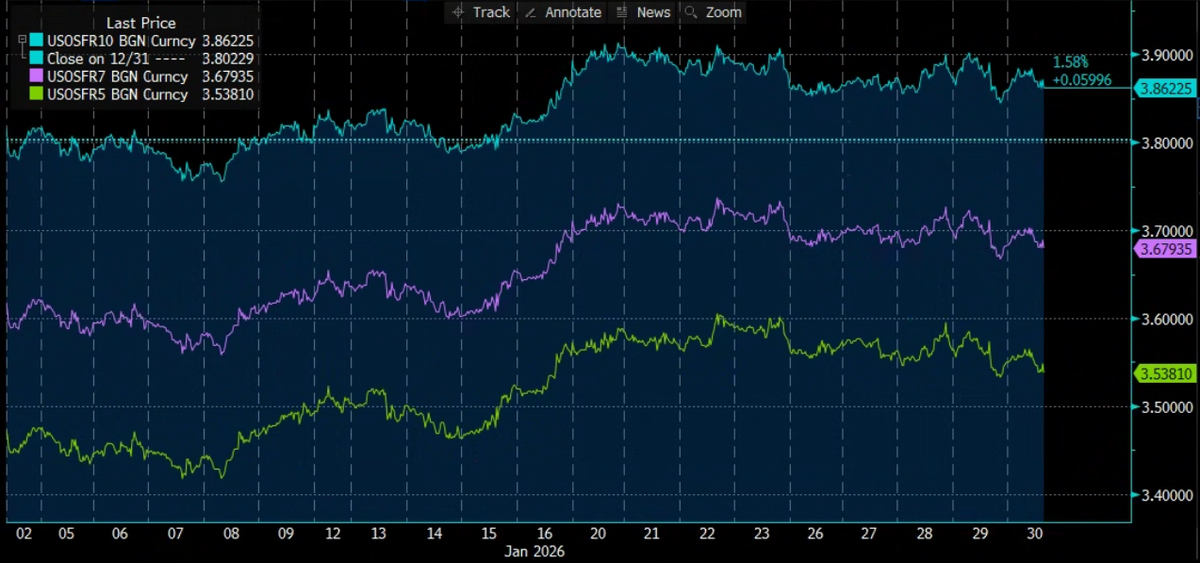
Source: Bloomberg, LLP | 5Y (green), 7Y (purple) & 10Y (light blue) SOFR SWAP RATES, PRIOR 30 DAYS
CHART 3 & 3A: PPI RECAP – DECEMBER PPI WORSE-THAN-EXPECTED; MARKET REACTION MUTED
US wholesale prices rose by more than forecast in December, suggesting US companies are increasingly “passing on” tariff costs at the risk of keeping inflationary pressures elevated. Headline PPI rose 0.5% (vs. 0.2% expected), the most in three months. Core PPI, which strips out more volatile food and energy prices, jumped at one of the fastest rates of the year, 0.7%! Expectations had called for an increase of 0.2% in MoM core PPI. The December PPI report also showed that both headline and core annual price changes picked up, defying economists’ expectations for an easing. The primary culprit behind the increase in PPI was a uptick in service costs.
CHART 3:December PPI Prints Worse-Than-Expected, Defying Forecasts
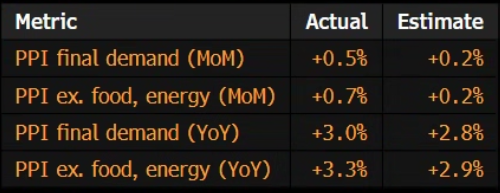
Source: Bloomberg, LLP | DECEMBER PPI RECAP
CHART 3A:Historical PPI Data Since December 2023
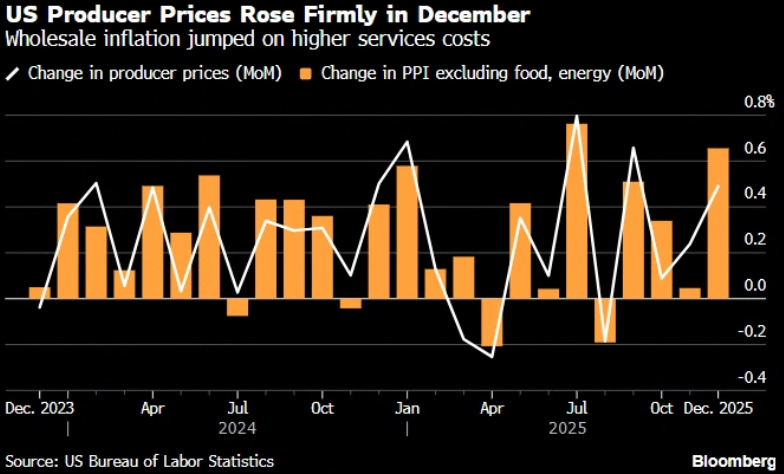
Source: Bloomberg, LLP | HISTORICAL PPI DATA
Disclaimer: The information provided in this communication is intended for discussion purposes only. Nothing presented in this communication should be taken as a recommendation or forecast. All market data shown is indicative only and subject to change depending on current market conditions. The information in this publication is confidential and is intended for the recipient only.