

Rate Markets Update · Monday, February 2, 2026
Rates Tick Higher as Traders Await Economic Data, Monitor Geopolitical Developments
- Government Shutdown "Part 2" Looms
Flash Update: US RATE MARKETS – MONDAY FEBRUARY 2, 2026
UST yields and SOFR swap rates opened slightly higher this morning; Traders await economic data and monitor several “hot spots”
Traders continue to closely monitor geopolitical developments (Greenland, Europe, Venezuela, Iran)
Volatility in the commodities market is capturing the market’s attention this morning
The pull-back in commodities pricing (gold, silver, crude oil) signals geopolitical tensions may be abating somewhat
Market participants will continue to monitor developments with the DOJ investigation into the US Central Bank
President Trump has selected Kevin Warsh as his nominee for the next FOMC Chairman
Market reaction to the announcement has been minimal, but this will be a developing story over the next few months
A potential government shutdown is also garnering market attention – another disruption to “data releases” could impact rates
A SCOTUS ruling on tariffs is now anticipated to come this month (Feb.) – the decision could come any day
The next FOMC rate decision is due Wednesday, March 18, 2026 at 2:00 PM
Next up for data: December JOLTS jobs report prints tomorrow, 2/3 at 8:30 AM
Short-end SOFR swap rates are trading up ~1-2 bps this morning, depending on tenor
Long-end SOFR swap rates are currently trading up ~1-2 bps, depending on tenor
Good Morning – US Treasury yields and SOFR swap rates opened a tick or two higher this morning, as traders monitor a number of market “hot spots” and await economic data. Volatility across commodities is shaping up to be the center of attention in markets today. Gold trimmed losses after falling as much as 10%. At one point, silver prices sank 16% before reversing most of the retreat. Oil prices tumbled nearly 5% after President Trump said Washington is “talking” with Iran. The drop in commodities prices could be a signal that geopolitical tensions are easing back from the critical levels we experienced the past two weeks with Greenland and Iran.
Traders will continue to monitor several market “hot spots” that could impact US rates including a potential US government shutdown, simmering geopolitical tensions and the next series of key economic data. Key economic data on the horizon includes: January ISM Manufacturing data this morning at 10:00 AM; December JOLTS jobs report on 2/03; January ISM Services data on 2/4; January CPI on 2/11; January Employment Report on 2/6.
News the market is tracking includes:
Geopolitical developments continue to weigh on market sentiment. Geopolitical tensions continue to run high, and that is not likely to materially abate anytime soon. Markets will continue to closely monitor the situations in Venezuela, Europe, Iran and Greenland. This morning, President Trump said that the US and Iran are in “serious discussions”, which could help to deescalate the situation and ease global tensions.
Markets will be tracking developments in the US equities markets closely. There is still a sharp focus on the performance of the growing AI sector. Market sentiment is likely to be impacted by “tech” earnings for the foreseeable future.
The Supreme Court ruling on President Trump’s tariffs has not yet been released. The ruling is now expected to come this month. The SCOTUS ruling could definitely have market implications. Currently, market participants and economists believe the Supreme Court will rule against the President. Economists are unsure about the market impact of the decision – either way, the ruling is a potential catalyst for elevated rate volatility.
SCOTUS is also currently ruling on the legality of the President firing of the Fed’s Lisa Cook. That ruling is also expected to come in the near term. Chair Powell said yesterday that this is “the most important legal case in the Fed’s history”. Stay tuned!
President Trump has “asked” Fannie Mae and Freddie Mac to purchase ~$200 billion in mortgage-backed securities in order to facilitate lower mortgage rates. The market impact is uncertain at the moment. A sudden surge in purchases could impact rates and the shape of the yield curve, at least in the short-term. We will continue to track this developing story.
The US Justice Department investigation into the US Central Bank and Chairman Powell is likely to remain a key market focus moving forward.
Traders will continue to track developments with the US dollar – the recent weakness, and reaction of the US government, has baffled markets. Sustained currency weakness can be inflationary. A weak dollar can lead to “pricier” imports and a deterioration in investor confidence.
Bottom-line, there are many potential market catalysts for traders to monitor and manage at the moment.
SOFR Swap Rate Summary: The 1Y SOFR swap rate is trading up ~1-2 bps this morning. 2Y and 3Y SOFR swap rates are currently trading up ~1-2 bps. 5Y and 10Y SOFR swap rates are currently trading up ~1-2 bps on the day. The very back-end of the swap curve is currently trading up ~1-2 bps from yesterday’s closing levels.
Please note: Market levels can change rapidly – rate cap premiums are subject to a dynamic market that can change frequently.
CHART 1:US RATES SNAPSHOT: 9:45 AM Eastern
*For SOFR Swap Rates & Change-On-Day (In Bps): Refer Two Far Right Columns (SOFR Swap Rates)
UST YIELDS | SWAP SPREADS | SOFR SWAP RATES
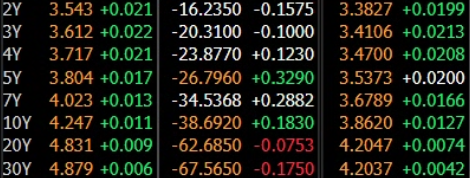
Source: Bloomberg, LLP | 9:45 AM NY Rates Snapshot
CHART 2, 2A & 2B: SOFR SWAP RATES TICK SLIGHTLY HIGHER AS MARKET AWAITS CATALYSTS
SOFR swap rates opened a touch higher this morning as traders await the next series of economic data and monitor a number of market ‘hot spots”. The market is definitely tracking a number of potential catalysts this week. That said, SOFR swap rates did not move materially last week. The 2Y swap rate opened last Monday at 3.433% and is now trading at 3.382%. The 10Y swap rate was 3.872% a week ago and is currently trading at 3.862%.
Rate cut odds ticked slightly lower this morning, but nothing dramatic. Here are the current odds for a Fed rate cut at the next four meetings: March, 12.9% (vs. 15.5% last); April, 29.1% (vs. 31.2% last); June, 65.8% (vs. 65.4% prior); July, 77.4% (vs. 77.6% prior). Right now, traders do not expect a rate cut in the first quarter of 2026, but they do suspect that the installment of a new Fed chief could green-light a rate cut in June or July. Currently, forward market pricing implies 50.8 bps of cumulative rate cuts in 2026 (~two, 25 bp rate cuts) – that number was 49.9 bps on Friday. As you can see, the Warsh nomination has thus far done little to materially impact Fed rate cut forecasts.
CHART 2:Short-End SOFR Swap Rates – Prior 30 Days
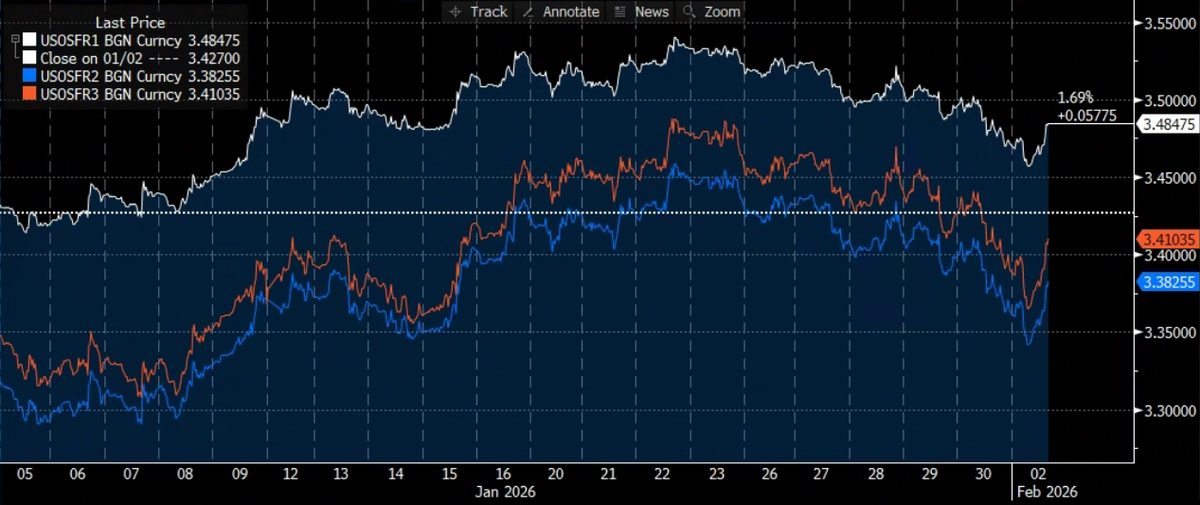
Source: Bloomberg, LLP | 1Y (white), 2Y (blue) & 3Y (orange) SOFR SWAP RATES, PRIOR 30 DAYS
CHART 2A:Long-End SOFR Swap Rates – Prior 30 Days
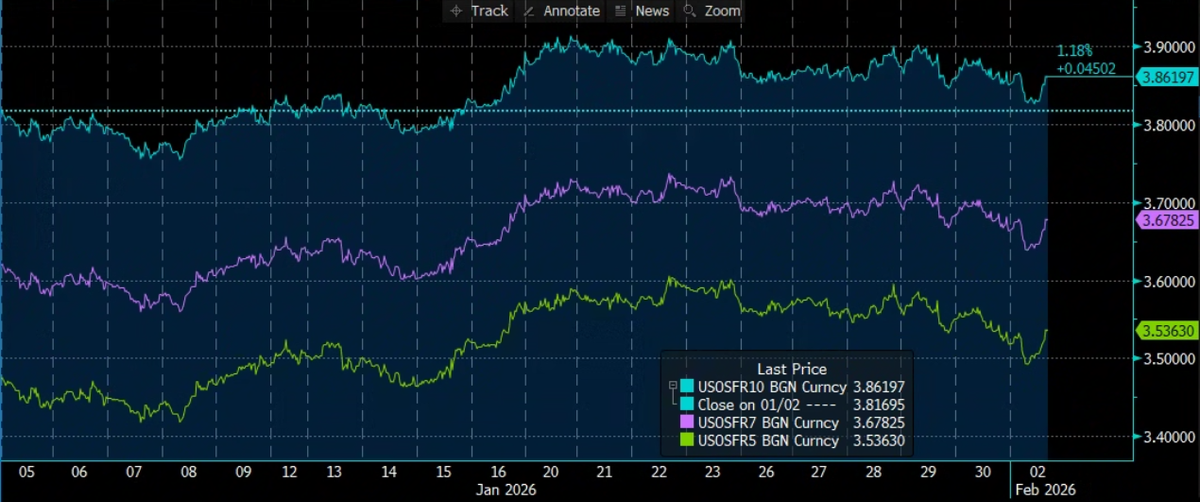
Source: Bloomberg, LLP | 5Y (green), 7Y (purple) & 10Y (light blue) SOFR SWAP RATES, PRIOR 30 DAYS
Disclaimer: The information provided in this communication is intended for discussion purposes only. Nothing presented in this communication should be taken as a recommendation or forecast. All market data shown is indicative only and subject to change depending on current market conditions. The information in this publication is confidential and is intended for the recipient only.