
Rate Markets Update · Monday, April 13, 2026
Rates Tick Higher as Us/iran Ceasefire Falters
- Oil Prices Move Higher as US Threatens to Blockade Strait of Hormuz
Flash Update: US RATE MARKETS – MONDAY APRIL 13, 2026
UST yields and SOFR swap rates are ticking a touch higher this morning as traders anxiously monitor war developments
Oil prices topped $100 as the US ordered a blockade of the Strait of Hormuz
The first round of US/Iran negotiations held this past weekend ended in a deadlock
Traders continue to grapple with a range of possible outcomes for the war in the Middle East
The war in the Middle East remains the primary focus for the rate markets
The next FOMC rate decision is due Wednesday, April 29th at 2:00 PM
Next up for data: March PPI is released tomorrow, 4/14 at 8:30 AM
Short-term SOFR swap rates are trading up ~1 bp this morning, depending on tenor
Medium-term SOFR swap rates are up ~1 bp currently, depending on tenor
Long-end SOFR swap rates are up ~1 bp this morning, depending on tenor
Good Morning – US Treasury yields and SOFR swap rates are drifting higher this morning as the fragile ceasefire between the US and Iran shows signs it may be faltering. The first round of US/Iran negotiations held this weekend ended in a deadlock. Iran continues to lock-down the Strait of Hormuz, prompting the US to order a blockade of the Strait of Hormuz. As a result, oil prices pushed above $100 per barrel and rates are ticking higher.
The market will continue to be heavily “headline” driven – there are many, many rumors swirling around the market regarding how much progress is being made with diplomatic efforts to end the war. Thus far, the fragile ceasefire is holding. However, the US has announced that they will blockade the Strait of Hormuz in an effort to increase pressure on Iran to come back to the negotiating table and/or open the Strait of Hormuz. Bottom-line, progress on the diplomatic front will likely push rates lower – conversely, should diplomatic efforts prove fruitless, rates are likely to continue to push higher. Right now, as the war goes, so go rates.
Prepare for the possibility of “whip-saw” rate movements as negotiations between the US and Iran unfold – or conversely, if they do not unfold. Either development is likely to increase rate volatility. War developments and the associated “headlines” will continue to be the primary market catalysts for the near term.I advise staying nimble if you have upcoming caps or swaps to execute – market dynamics can and will change quickly as war “developments” unfold. It may take a few weeks for volatility to settle down and level-off. For the time being, market participants will continue to anxiously monitor the latest war developments.
News the market is tracking includes:
Geopolitical developments continue to weigh on market sentiment.The US/Iran “war” continues to dominate market sentiment this week. The end result of the US attack on Iran is difficult to forecast at this time.
SCOTUS is also currently ruling on the legality of the President firing of the Fed’s Lisa Cook. There are some reports stating that SCOTUS is nearing a final decision on that case, which could have far reaching implications for the US Central Bank.
The US Justice Department investigation into the US Central Bank and Chairman Powell will remain a key market focus moving forward.
Market participants continue to closely track developments in the US equities markets. There is still a sharp focus on the performance of the growing AI sector. Market sentiment is likely to be impacted by “tech” earnings for the foreseeable future.
The market continues to monitor US political developments. US political developments will remain a major focus for the market for the foreseeable future.
Traders and investors continue to assess the market implications of the recent SCOTUS ruling on President Trump’s tariffs. Market participants await more data and information.
Market participants are growing more and more concerned with the ongoing “partial” government shutdown. Traders are hoping the situation is resolved quickly – a full government shut-down would be extremely challenging to manage during a war.
SOFR Swap Rate Summary: The 1Y SOFR swap rate is trading up ~1 bp this morning. 2Y and 3Y SOFR swap rates are currently trading up ~1 bp. 5Y and 10Y SOFR swap rates are trading flat to up ~1 bp on the day. The very back-end of the swap curve is currently trading up ~1 bp from Friday’s closing levels.
Please note: Market levels can change rapidly – rate cap premiums are subject to a dynamic market that can change frequently.
CHART 1:US RATES SNAPSHOT: 9:15 AM Eastern
*For SOFR Swap Rates & Change-On-Day (In Bps): Refer Two Far Right Columns (SOFR Swap Rates)
UST YIELDS | SWAP SPREADS | SOFR SWAP RATES
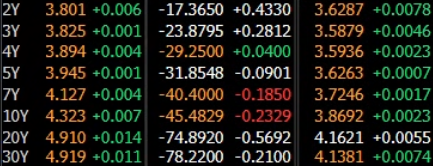
Source: Bloomberg, LLP | 9:15 AM NY Rates Snapshot
CHART 2, 2A, 2B & 2C: SOFR SWAP RATES TICK HIGHER AS FRAGILE US/IRAN CEASEFIRE FALTERS
SOFR swap rates are ticking slightly higher this morning as traders anxiously monitor war developments. Lack of progress on the negotiating front has led to higher oil prices and slightly higher SOFR swap rates.
We could be subject to elevated levels of rate volatility as the diplomatic/negotiation process unfolds. I still believe that, should a “real” resolution be reached relatively quickly, we could see rates drop to pre-war levels, potentially quickly and dramatically, as the energy and rate markets correct. However, make no mistake – should negotiations collapse, or lead nowhere, the conflict could ramp up again and reach a new level of intensity. In that case, there is plenty of room for rates to move higher from here. We are seeing a perfect example of that “war resumption impact” today with slightly higher swap rates.
Key Swap Rate Movements Since The US/Iran War Began:
The 2-year SOFR swap rate closed at 3.21% on Friday 2/27 – it is currently trading at ~3.63% (+42 bps). The 5-year SOFR swap rate closed at 3.22% on Friday 2/27 – it is currently trading at ~3.63% (+41 bps). The 10-year SOFR swap rate has experienced a similar move – it closed Friday 2/27 at 3.52% and is currently trading at ~3.87% (+35 bps).
CHART 2:Short-End SOFR Swap Rates – Since 3/3/2026
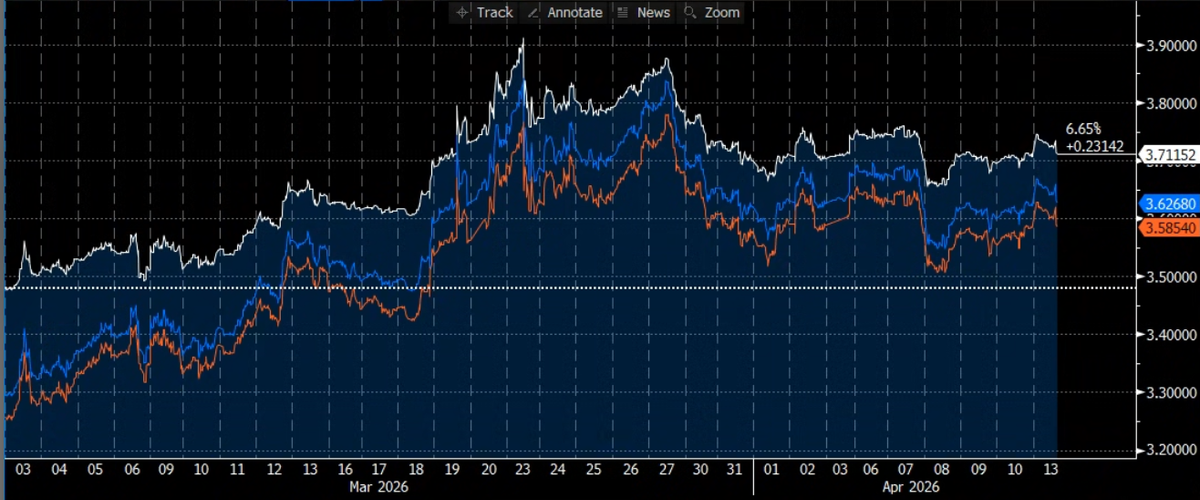
Source: Bloomberg, LLP | 1Y (white), 2Y (blue) & 3Y (orange) SOFR SWAP RATES, PRIOR 30 TRADING SESSIONS
CHART 2A:Long-End SOFR Swap Rates – Since 3/3/2026
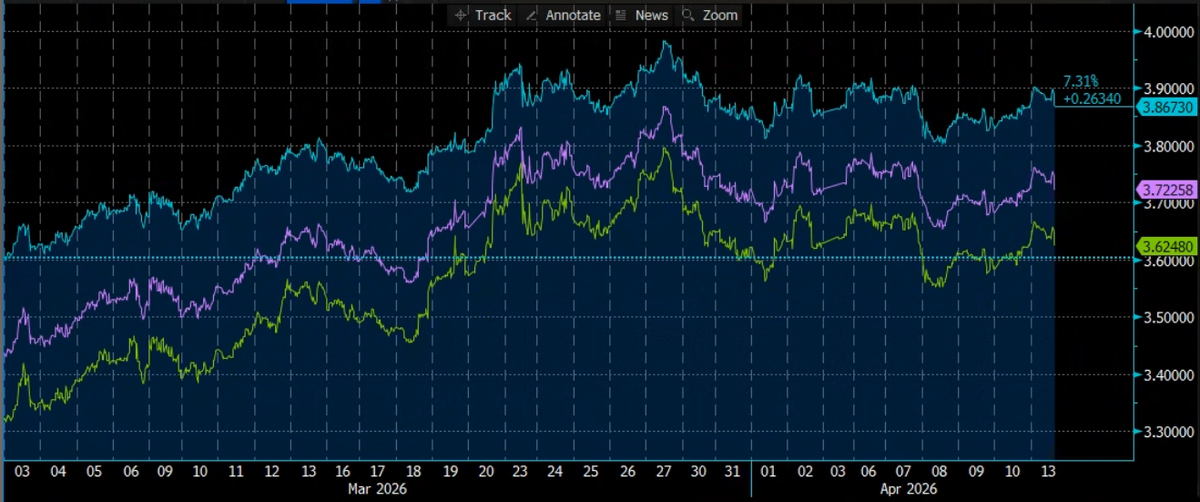
Source: Bloomberg, LLP | 5Y (green), 7Y (purple) & 10Y (light blue) SOFR SWAP RATES, PRIOR 30 TRADING SESSIONS
CHART 2B:10-Year US Treasury Note Yield Since October 2025
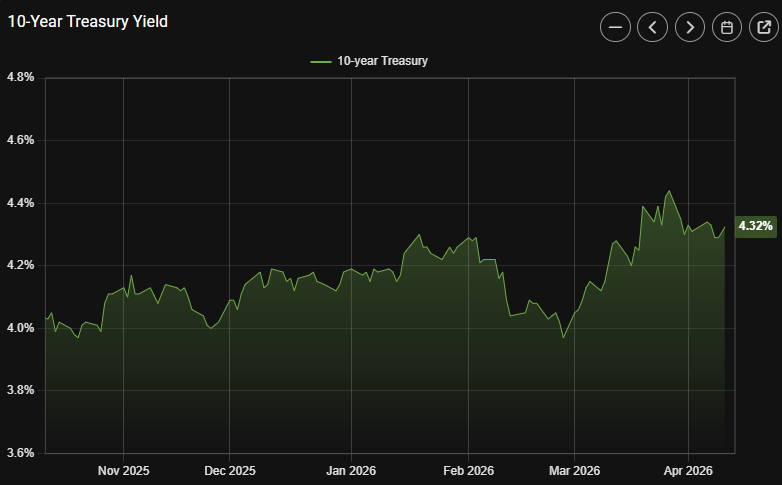
Source: StreetStats | 10-Year US Treasury Note Yield Prior 6-Months
RCA Product & Pricing Update:
Product Spotlight: What We Are Seeing In The Rates & Derivatives Markets
The market is again facing tremendous uncertainty surrounding the path forward for interest rates. Borrowers should be as nimble as possible in this market environment. Cap purchasers should onboard as quickly as possible – there is no cost to onboard. It is important to be in a position to take advantage of market opportunities quickly and efficiently.
Given the uncertainty that still remains about forward rates, many clients are grappling with when or if to extend. This is a difficult question – our advice has been to monitor the market closely and be on-boarded and ready to trade, should the market move in your favor. We also advise borrowers to check the market pricing for extensions, similar to how you purchased the original cap. Market pricing discovery is a key component to any cap transaction – new caps, extensions or terminations.
There is an increasing interest in exploring interest rate swaps as a possible hedge alternative. IR Swaps lock in a synthetic fixed rate and do not require an upfront premium. Unlike an interest rate cap, swaps are secured derivatives, so the counterparty selection process is more challenging with a swap. There are also additional variables that factor into the decision to pursue an interest rate swap, or to unwind an existing swap. We are also seeing a dramatic increase in swap termination advisory requests recently, as clients contemplate refinancings. Lower rates have sparked refinancing activity, which in some cases necessitates unwinding an existing swap. Please let us know if you would like to learn more about interest rate swaps, or swap terminations.
We are still seeing some residual demand for interest rate floor indications – to offset high loan floors or simply to benefit from declining variable rates. Borrowers who have “floors” embedded in their loans have been considering purchasing a separate, stand-alone interest rate floor to offset the loan floor.
Interest Rate Cap Hub: Pricing & Volatility Update for 4/13/2026
Cap premiums are fluctuating as rates bounce around in reaction to diplomatic efforts to end the war
Rate volatility has ticked significantly higher since the onset of the Middle East conflict, but has settled down a touch this week
Cp premiums have moved lower week given the recent drop in volatility and a slight drop in SOFR swap rates
Current 1-Month Term SOFR = 3.64863% (Prior day: 3.65178%)
Pricing Matrix:1-Week Movement In 1-Month Term SOFR Cap Premiums
Notional Amount | Tenor | Strike Rate | ~Premium 4/6/26 | ~Premium 4/13/26*^ |
$25,000,000 | 1-Year | 3.50% | ~$104k | ~$99k |
$25,000,000 | 1-Year | 4.50% | ~$26k | ~$27k |
$25,000,000 | 2-Year | 3.50% | ~$246k | ~$226k |
$25,000,000 | 2-year | 4.50% | ~$82k | ~$73k |
$25,000,000 | 3-Year | 3.50% | ~$419k | ~$391k |
$25,000,000 | 3-Year | 4.50% | ~$173k | ~$160k |
*Indications as of market open. Premium levels provided are indications only and subject to change.
^NOTE: MARKET DYNAMICS AND PRICING CAN CHANGE VERY QUICKLY IN THIS MARKET ENVIRONMENT.
WE RECOMMEND YOU CALL US FOR ACCURATE, UP-TO-THE-MINUTE CAP INDICATIONS.
Please contact us if you would like to discuss an upcoming rate cap or rate cap extension, explore ways to reduce or eliminate escrow deposits for replacement caps or learn more about interest rate Caps, Floors, Swaps or Swaptions. RCA can also assist you with the voluntary early termination of your cap or swap.
HedgeWithAnEdge-TheRCAEdge!

Disclaimer: The information provided in this communication is intended for discussion purposes only. Nothing presented in this communication should be taken as a recommendation or forecast. All market data shown is indicative only and subject to change depending on current market conditions. The information in this publication is confidential and is intended for the recipient only.