

Rate Markets Update · Monday, August 24, 2026
Rates Mostly Steady as Market Particpants Prepare for a Potentially "Big Week"
- Key Economic Data Prints Wed. 8/26
Flash Update: US RATE MARKETS – MONDAY AUGUST 24, 2026
Short-end UST yields and SOFR swap rates are holding mostly steady this morning; the longer end of the yield curve is slightly lower this morning
There is growing speculation that there will be further US Treasury Department “intervention”, which is helping push down long-term rates slightly this morning
The US and Canada appear poised for another trade war – currently, markets are in “observe and report” mode surrounding the new tariffs
The US-Iran conflict remains the primary driver for the rate markets
Elevated oil prices have put inflation risks back on market participants’ radar and increased market uncertainty
Traders continue to anxiously monitor the conflict in the Middle East and remain in a “wait-and-see” mode
The next FOMC rate decision is due on Wednesday, September 16th at 2:00 PM
Due to the ongoing conflict in the Middle East and uptick in oil prices, odds for a September Fed rate hike have edged up to ~40.9%
Next up for key economic data: 2Q GDP, Aug. PCE, Aug. Personal Income and Aug. Personal Spending are all due for release on Wednesday 8/26 at 8:30 AM
Short-term SOFR swap rates are trading up ~1 bp this morning, depending on tenor
Medium-term SOFR swap rates are down ~1 bp currently, depending on tenor
Long-end SOFR swap rates are trading down ~1-2 bps this morning, depending on tenor
Good morning – Short-term rates are holding mostly steady this morning, up ~1 bp or so. Inflation sensitive medium- and long-term rates are down a bit this morning (~1-2 bps), as traders anticipate further US Treasury Department intervention. We know that the Administration wants lower rates – we also know that objective is extremely challenging given the conflict in the Middle East and mounting fear of higher inflation. Treasury Secretary Bessent has a tough job ahead of him, but I do expect him to use all the tools at his disposal to improve liquidity and lower long-term rates. CNBC published a story this morning stating that the US Treasury Department could opt to draw down some of its cash reserves to fund expanded buybacks of higher-yielding, older securities. I anticipate this is just the beginning of Mr. Bessent’s efforts to curtail the increase in rates and improve overall market liquidity.
The other news story capturing the market’s attention this morning is the collapse of trade talks between the US and Canada. Canada rejected the latest US trade proposal, leading to the US implementation of a 50% tariff against many Canadian goods. Canada responded with counter-tariffs on billions of dollars of US goods through September 8th. This simply sets the stage for a potentially protracted trade war between the US and Canada. With fear of higher inflation already squarely centered in the market’s spotlight, a new trade war is the last thing the market wants to see. This is a developing story with the potential to be resolved quickly. So far this morning, the market reaction has been muted.
The news out of the Middle East was relatively subdued over the weekend. Brent crude oil is holding at ~$93 a barrel. Rates are likely to continue to generally track the direction of oil prices for the near term, but many uncertainties remain:
There is still a high level of uncertainty surrounding the outcome of the conflict in the Middle East and oil prices remain elevated. The longer the conflict lingers, the greater the inflation threat and the possibility for sustained higher rates.
The US Treasury Department is now clearly in “intervention mode”. We can expect more announcements and policy tweaks in the coming weeks.
We will see the next series of key economic and inflation data beginning on Wednesday, 8/26. Given the tight-lipped Fed, I expect economic data to be even more important for traders going forward.
The next “big” economic data event is on 8/26, when we will see PCE, 2Q GDP, Personal Income and Personal Spending all released at 8:30 AM. Overall, I do not expect a material dip in rates until the conflict in the Middle East is resolved. Further Treasury Department intervention and policy adjustments may help some, but for now that remains a huge wildcard for the market. I do not think last week’s intervention met the objective – the market quickly shook it off. So, it’s back to the drawing board for Treasury Secretary Bessent. Bottom line, market uncertainty regarding the path forward for interest rates remains at elevated levels – I anticipate market “uncertainty” to remain elevated for the foreseeable future.
CHART OF THE DAY: Secretary Bessent Wants Lower Treasury Rates – He May Quickly Find There Is No Easy Fix
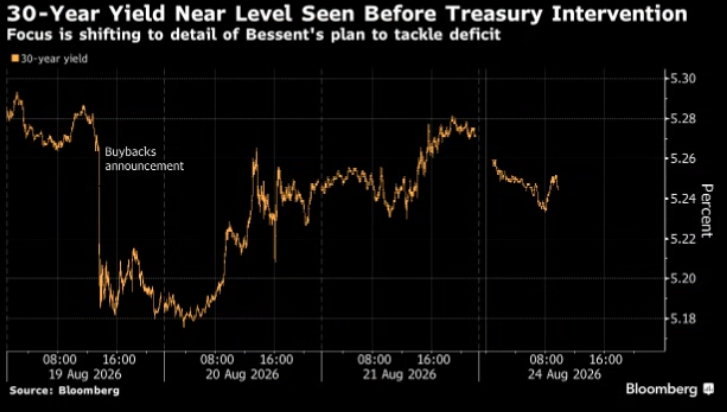
Source: Bloomberg, LLP | 30-YEAR UST BOND YIELD MOVEMENT SINCE US TREASURY DEPARTMENT INTERVENTION ON AUGUST 19, 2026
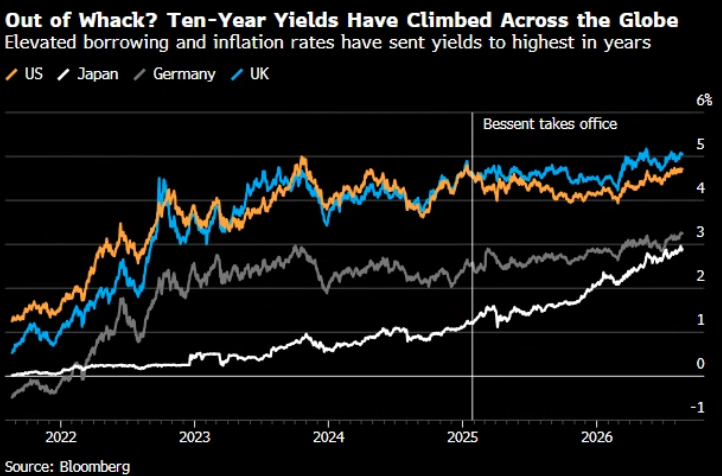
Source: Bloomberg, LLP | GLOBAL 10-YEAR BOND YIELDS SINCE 2H 2021
“Key News” the market is tracking includes:
Geopolitical developments continue to weigh on markets.Developments in the US/Iran “war” will continue to dominate market sentiment.
Lack of forward guidance from the Fed is forcing traders to pay more attention to economic data – this may fundamentally change the way markets position for and react to Fed rate announcements. Stay tuned!
Market participants continue to track developments in the US equities markets. There is still a sharp focus on the performance of the growing AI sector. Overall market sentiment, and perhaps even economic performance, may be impacted by tech-sector results for the foreseeable future.
Tariffs remain in focus, particularly the developing situation between the US and Canada. On many levels, more tariffs are last thing global markets need right now – they are already grappling with massive inflation uncertainty due to the conflict in the Gulf. This is a developing story - the market impact is undetermined currently.
The US Treasury Department’s bond market intervention this week sets the stage for more to come. Stay tuned!
SOFR Swap Rate Quick Summary:
The 1Y SOFR swap rate is trading up ~1 bp this morning. 2Y and 3Y SOFR swap rates are currently trading up ~1 bp. 5Y and 10Y SOFR swap rates are trading down ~1 bp this morning. The very back-end of the swap curve (20Y and 30Y) is currently down ~1-2 bps from Friday’s closing levels.
Please note: Market levels can change rapidly – rate cap premiums are subject to a dynamic market that can change frequently.
CHART 1:US RATES SNAPSHOT: 9:15 AM Eastern
Chart 1 Key:
Far Left Columns:US Treasury Yields & Change on Day (bps)
Center Columns:SOFR OIS Swap Spreads (bps) & Change on Day (bps)
Far Right Columns:SOFR OIS Swap Rates & Change on Day (bps)
UST YIELDS | SWAP SPREADS | SOFR SWAP RATES
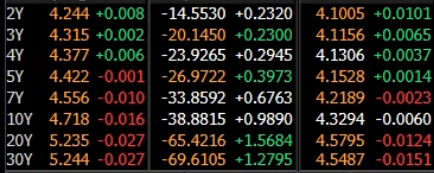
Source: Bloomberg, LLP | 9:15 AM NY Rates Snapshot
CHART 2, 2A & 2B: SOFR SWAP RATES MOSTLY STEADY AS MARKET EYES MORE TREASURY DEPARTMENT INTERVENTION
SOFR swap rates are holding mostly steady on the short-end and have dipped a couple of basis points on the long-end of the curve this morning. Despite some pockets of “whipsaw” rate volatility, SOFR swap rates were little changed last week. This week we could see an uptick in volatility – the US/Canada trade drama, ongoing Gulf conflict, US Treasury Department intervention and a full plate of economic data are all in play for the rate markets this week!
Overall, we are still seeing swaps trading in the “narrow range” summer markets we have been experiencing the past three weeks. Lack of key economic data and tremendous uncertainty surrounding the Middle East have kept SOFR swap rates range bound. The Treasury Department intervention was an unexpected, but welcome wildcard for the Treasury and swap markets. I expect to hear a lot more from Mr. Bessent in the coming weeks, perhaps days. He will likely try to use all the tools at his disposal to keep rates from running away to the upside. As we saw last week, that objective may be tougher to achieve than he thinks. We will also see some key economic data this week, which may help to shape the market’s view on rates.
US-IRAN WAR IMPACT: Key SOFR Swap Rate Movements Since The US-Iran War Began
The 2-year SOFR swap rate closed at 3.21% on Friday 2/27/2026 – it is currently trading at ~4.101%(+89.1 bps)
The 5-year SOFR swap rate closed at 3.22% on Friday 2/27/2026 – it is currently trading at ~4.153%(+93.3 bps)
The 10-year SOFR swap rate closed at 3.52% on Friday 2/27/2026 – it is currently trading at ~4.329%(+80.9 bps)
CHART 2:Short-End SOFR Swap Rates – Year-To-Date 2026
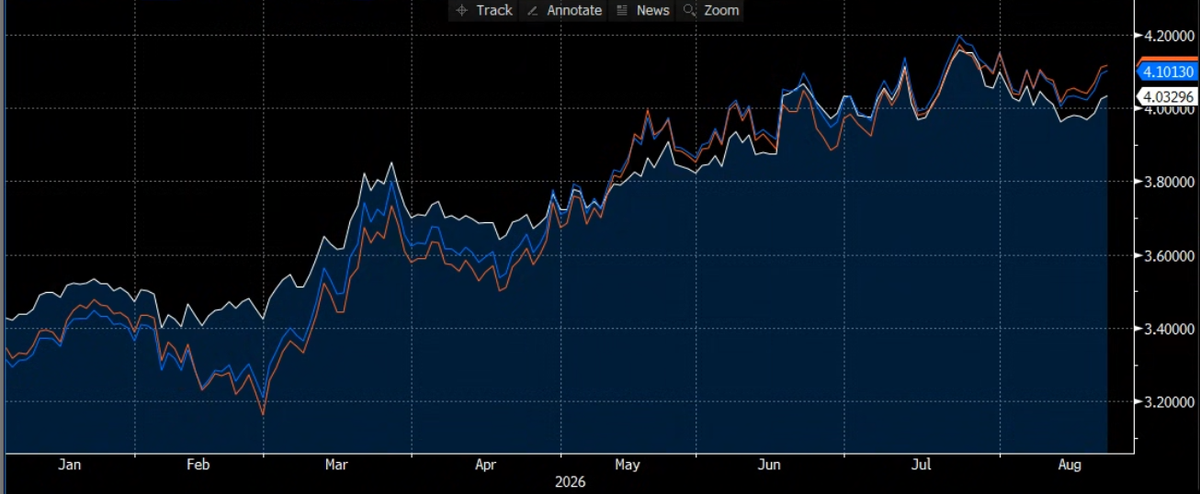
Source: Bloomberg, LLP | 1Y (white), 2Y (blue) & 3Y (orange) SOFR SWAP RATES; YTD 2026
CHART 2A:Long-End SOFR Swap Rates – Year-To-Date 2026
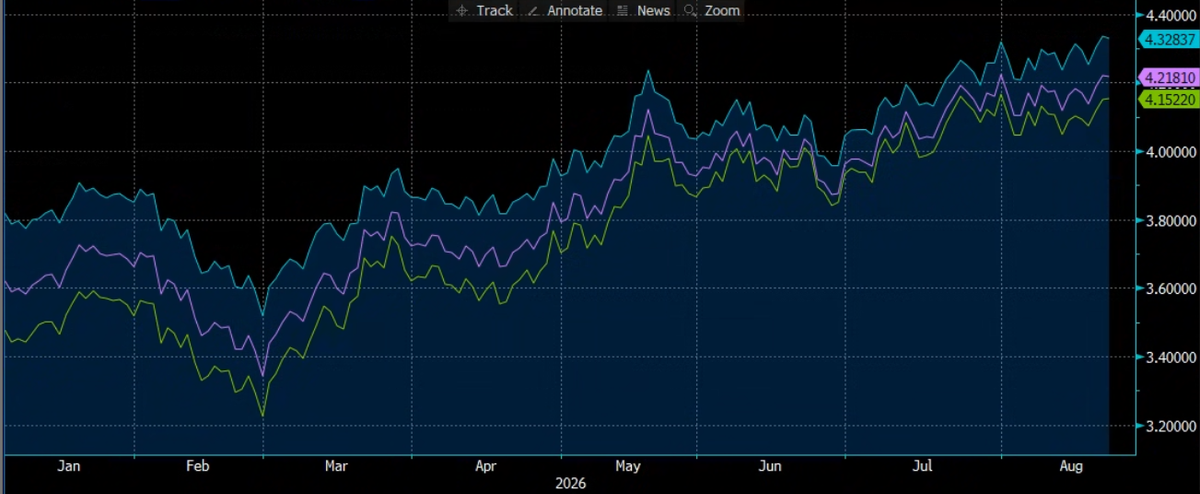
Source: Bloomberg, LLP | 5Y (green), 7Y (purple) & 10Y (light blue) SOFR SWAP RATES; YTD 2026
CHART 2B: US Treasuries: Yield Overview – Year-To-Date 2026
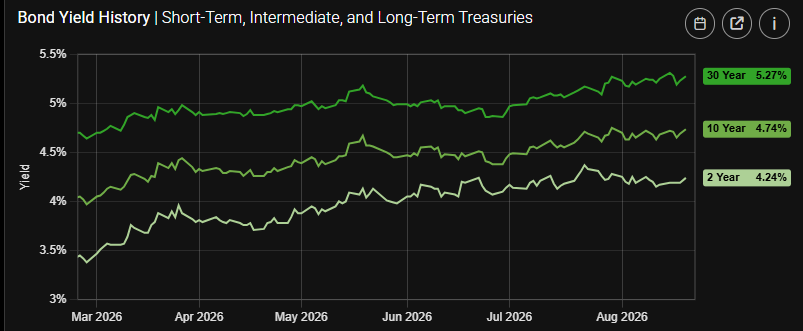
Source: StreetStats | US Treasury Yields; YTD 2026 (30Y UST yield – top line; 10Y UST yield – middle line; 2Y UST yield – bottom line)
RCA Product & Pricing Update:
Product Spotlight: What We Are Seeing In The Rates & Derivatives Markets
The market is once again facing tremendous uncertainty surrounding the path forward for interest rates. Borrowers should be as nimble as possible in this market environment. Cap purchasers should onboard as quickly as possible – there is no cost to onboard. It is important to be in a position to take advantage of market opportunities quickly and efficiently.
Given the high-level of uncertainty surrounding forward rates, many clients are grappling with when or if to extend. This is a difficult question – our advice has been to monitor the market closely and be on-boarded and ready to trade, should the market move in your favor. We also advise borrowers to check the market pricing for extensions, similar to how you purchased the original cap. Market pricing discovery is a key component to any cap transaction – new caps, extensions or terminations.
There is an increasing interest in exploring interest rate swaps as a possible hedge alternative. IR Swaps lock in a synthetic fixed rate and do not require an upfront premium. Unlike an interest rate cap, swaps are secured derivatives, so the counterparty selection process is more challenging with a swap. There are also additional variables that factor into the decision to pursue an interest rate swap, or to unwind an existing swap. We are also seeing a dramatic increase in swap termination advisory requests recently, as clients contemplate refinancings. Lower rates have sparked refinancing activity, which in some cases necessitates unwinding an existing swap. Please let us know if you would like to learn more about interest rate swaps, or swap terminations.
We are still seeing some residual demand for interest rate floor indications – to offset high loan floors or simply to benefit from declining variable rates. Borrowers who have “floors” embedded in their loans have been considering purchasing a separate, stand-alone interest rate floor to offset the loan floor.
Interest Rate Cap Hub: Pricing & Volatility Update for 8/24/2026
Current 1-Month SOFR = 3.66727%(Prior Day’s Reset: 3.65872%)
Despite pockets of elevated volatility this week, rate volatility remains relatively subdued overall
Given the possibility of additional Treasury Department intervention and the full plate of key economic data on tap, we may see an uptick in volatility this week
Cap premiums are holding relatively steady as SOFR swap rates are currently trading in a narrow range
Cap Pricing Matrix:1-Month Term SOFR Cap Premiums: Week-On-Week
Notional Amount | Tenor | Strike Rate | ~Premium 8/17/26 | ~Premium 8/24/26*^ |
$25,000,000 | 1-Year | 3.50% | ~$134k | ~$138k |
$25,000,000 | 1-Year | 4.50% | ~$27k | ~$29k |
$25,000,000 | 2-Year | 3.50% | ~$329k | ~$336k |
$25,000,000 | 2-year | 4.50% | ~$111k | ~$107k |
$25,000,000 | 3-Year | 3.50% | ~$539k | ~$550k |
$25,000,000 | 3-Year | 4.50% | ~$207k | ~$214k |
*Indications as of Market Open. Premium levels provided are indications only and subject to frequent change.
CHART 3:Historical Volatility: MOVE Composite US Treasury Yield Volatility Index - Year-To-Date 2026
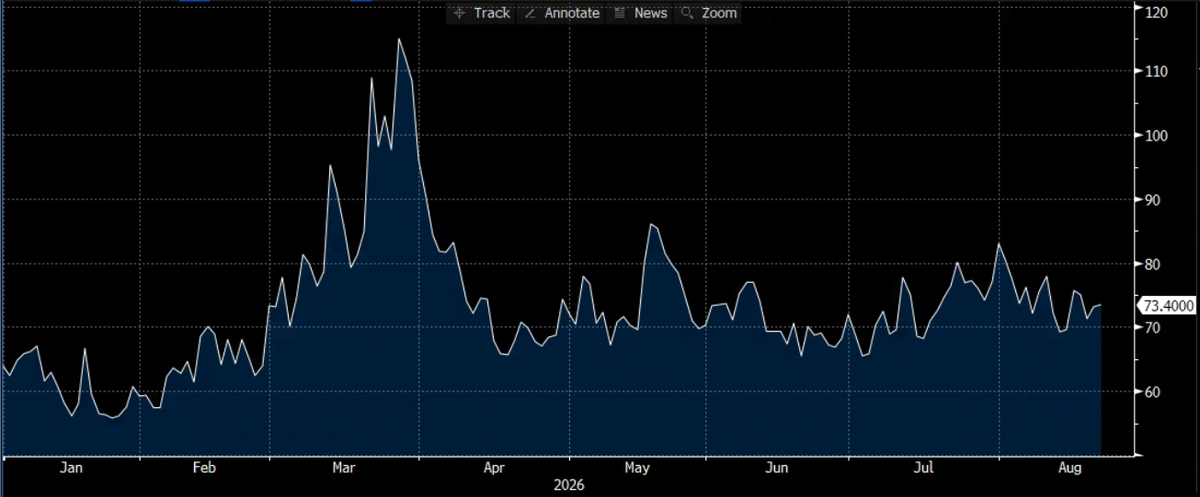
Source: Bloomberg, LLP | HISTORICAL US TREASURY YIELD VOLATILITY, “MOVE” INDEX – YTD 2026
^NOTE:RATE MARKETS CAN BE VOLATILE - MARKET DYNAMICS AND PRICING CAN CHANGE VERY QUICKLY IN THIS MARKET ENVIRONMENT.
**WE RECOMMEND YOU CALL US FOR ACCURATE, UP-TO-THE-MINUTE CAP INDICATIONS.**
Please contact us if you would like to discuss an upcoming rate cap or rate cap extension, explore ways to reduce or eliminate escrow deposits for replacement caps or learn more about interest rate Caps, Floors, Swaps or Swaptions. RCA can also assist you with the voluntary early termination of your cap or swap.
HedgeWithAnEdge-TheRCAEdge!

Disclaimer: The information provided in this communication is intended for discussion purposes only. Nothing presented in this communication should be taken as a recommendation or forecast. All market data shown is indicative only and subject to change depending on current market conditions. The information in this publication is confidential and is intended for the recipient only.